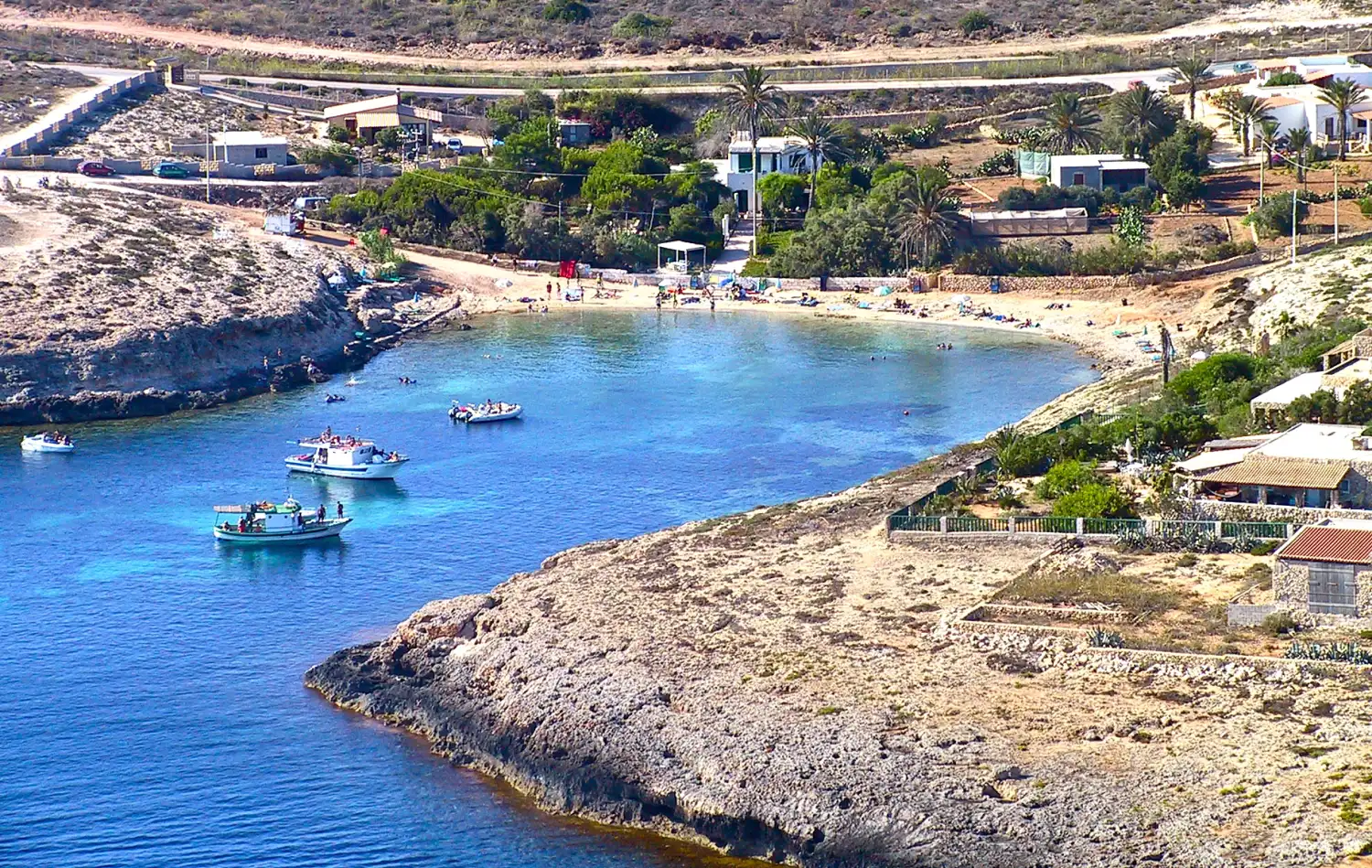
Cala Francese, the rocky cove made for shore snorkelling
A fold in the rock outside town, where the water shifts from turquoise to emerald green. When the sea is flat, few places on the island reward a mask and snorkel like this one.
Tomorrow: sirocco (south-easterly) 8 knots. This cove is exposed, expect waves and cloudy water. Better to switch to Cala Pisana, Cala Creta, Mare Morto. Full wind guide
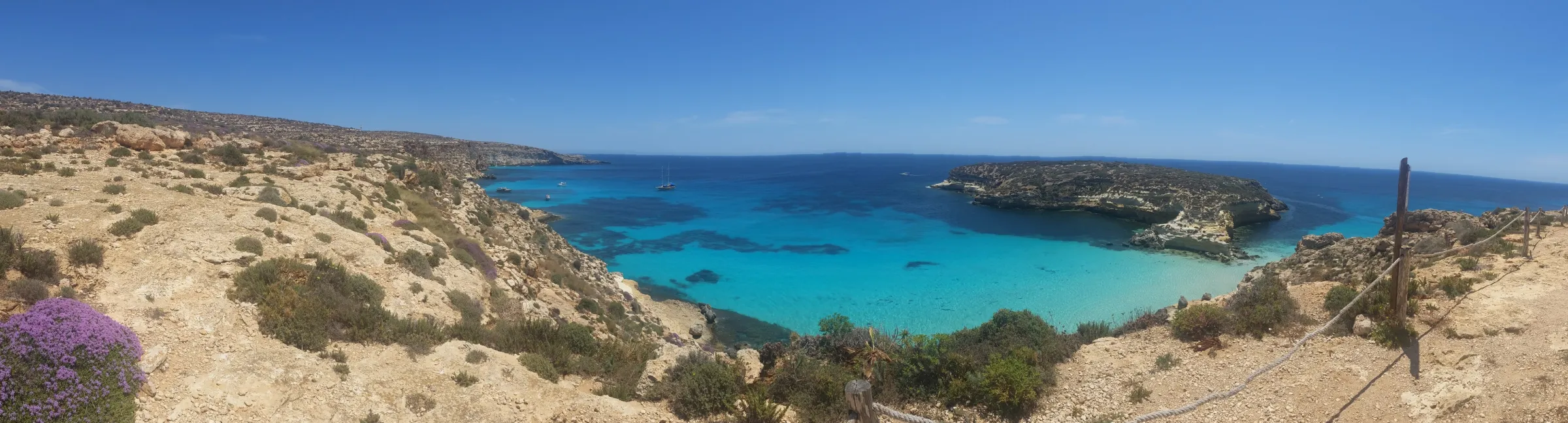
Cala Francese opens onto the south-east coast of Lampedusa, just past the airport, along a low shoreline cut by rock. It is not a broad beach but a narrow inlet, with a tongue of sand mixed with gravel and stone running between two pale walls. The sand is not the white you find at Guitgia or Cala Croce, yet the colour of the water makes up for it, turning from turquoise near the shore to emerald green where the bottom drops away.
This cove stays quiet even in August, which is both its strength and its catch. Behind it, towards Punta Sottile, the ground still carries the marks of the old quarries where blocks of stone were cut out, sharp incisions and squared-off faces still easy to read in the landscape. There is nothing on site, no kiosk, no built shade, no lifeguard. You have to turn up self-sufficient, with water, a hat and a towel that sits on stone.
| Access | by car or scooter |
|---|---|
| Distance | 2.5 km from town, 35 minutes on foot |
| Seabed | sand and rock |
| Depth | medium |
| Shade | none |
| Facilities | none |
| Parking | limited |
| With children | with care |
| Snorkeling | among the best on the island |
| Sheltered from | northerly (tramontana), mistral (north-westerly), westerly (ponente) |
| Exposed to | sirocco (south-easterly), easterly (levante), southerly (ostro) |
Getting there
- From town take the road heading east past the airport and follow the signs for Cala Francese.
- By scooter or car it is a few minutes from the centre, on foot it is a long walk in full sun.
- Leave the vehicle in the clearing at the entrance: it holds few cars and fills up before ten in high season.
- The last stretch to the water crosses uneven rock, so wear closed shoes or sandals with a sole, not flip-flops.
The seabed and what you see through the mask
The water deepens gradually, but the bottom is mixed, sand across the open stretches, slabs and boulders along the walls, and a few rocks breaking the surface. The best place to get in is the strip of sand in the middle of the cove, where you can put your feet down without slipping, while the side rocks are best avoided, wet and sharp as they are. Once in, follow the wall to the right or the left instead of heading straight out.
The crevices under the rock are the interesting part. You will usually find shoals of damselfish, sea bream and rainbow wrasse, the odd saddled bream further out and octopus tucked into the cracks. Sea urchins, limpets and small molluscs cling to the slabs, while patches of posidonia appear further down. There is no need to swim far from shore: the three or four metres of water under the wall are richer than the sandy middle. On a flat sea visibility stays excellent.
Why the early morning is worth the effort
The cove is at its best in the first hours of the day. The sea is usually calmer than it will be by the afternoon, when the breeze picks up, ruffles the surface and cuts visibility underwater. The sand on the bottom has not been stirred up by swimmers, so you see far more through the mask. The parking area is still free, too, and the rock wall casts a band of shade along its base, though it pulls back by mid-morning and does not return.
The wind that opens it and the wind that closes it
Cala Francese faces south-east, and that decides everything. With mistral (north-westerly), tramontana (northerly) or ponente (westerly) it stays sheltered, the water still and clear, ideal conditions for a mask. With sirocco (south-easterly), levante (easterly) or any southerly the sea runs straight into the inlet, lifts the sand and clouds it, and snorkelling stops making sense. On those days move to the east or north-east side, towards Cala Pisana, Cala Creta or Mare Morto. Check the forecast the night before.
Nothing is provided here, you bring it
Plan around a complete absence of facilities. Do not count on a kiosk, a toilet or sunbeds for hire, because everything you need comes in with you and everything goes out again, rubbish included. Natural shade is minimal and disappears once the sun is high, so bring an umbrella or a shelter, plenty of water and sunscreen. Town is only minutes away, which helps, but with small children it pays to sort yourself out beforehand.
Reef shoes, not flip-flops
The mixed bottom and the rocks just under the surface make getting in and out the trickiest moment of the day. A pair of reef shoes lets you enter and leave without cutting yourself or slipping, and lets you walk across the slabs to find the right starting point.
You are inside a Marine Protected Area
Swimming and snorkelling are allowed, but the rules of the Isole Pelagie Marine Protected Area apply: do not touch or prise organisms off the rocks, do not collect sea urchins, shells or stones, and do not feed the fish. If you arrive by sea, never anchor on posidonia. The detailed rules are on the managing authority's website.
Where Cala Francese is
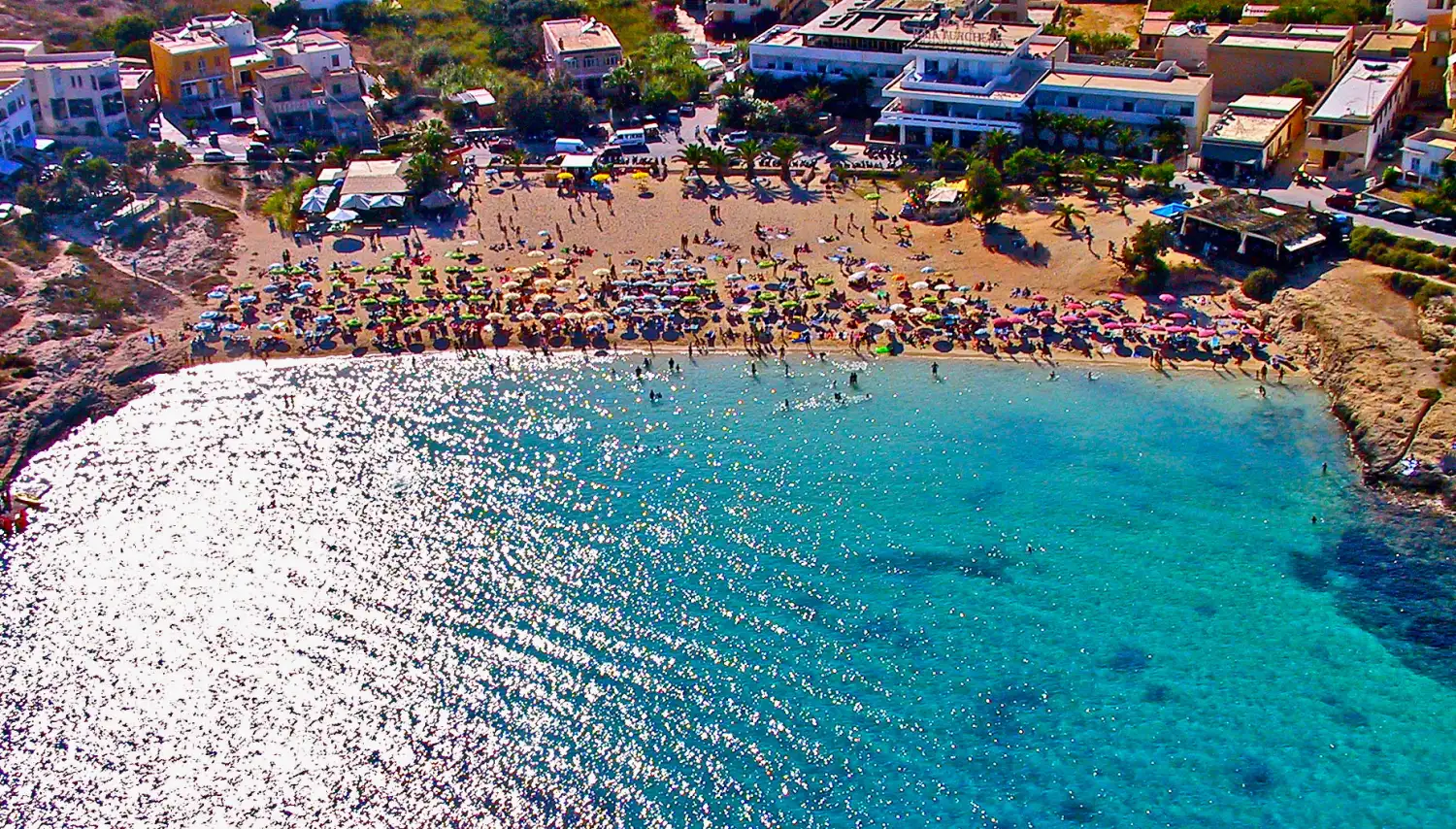
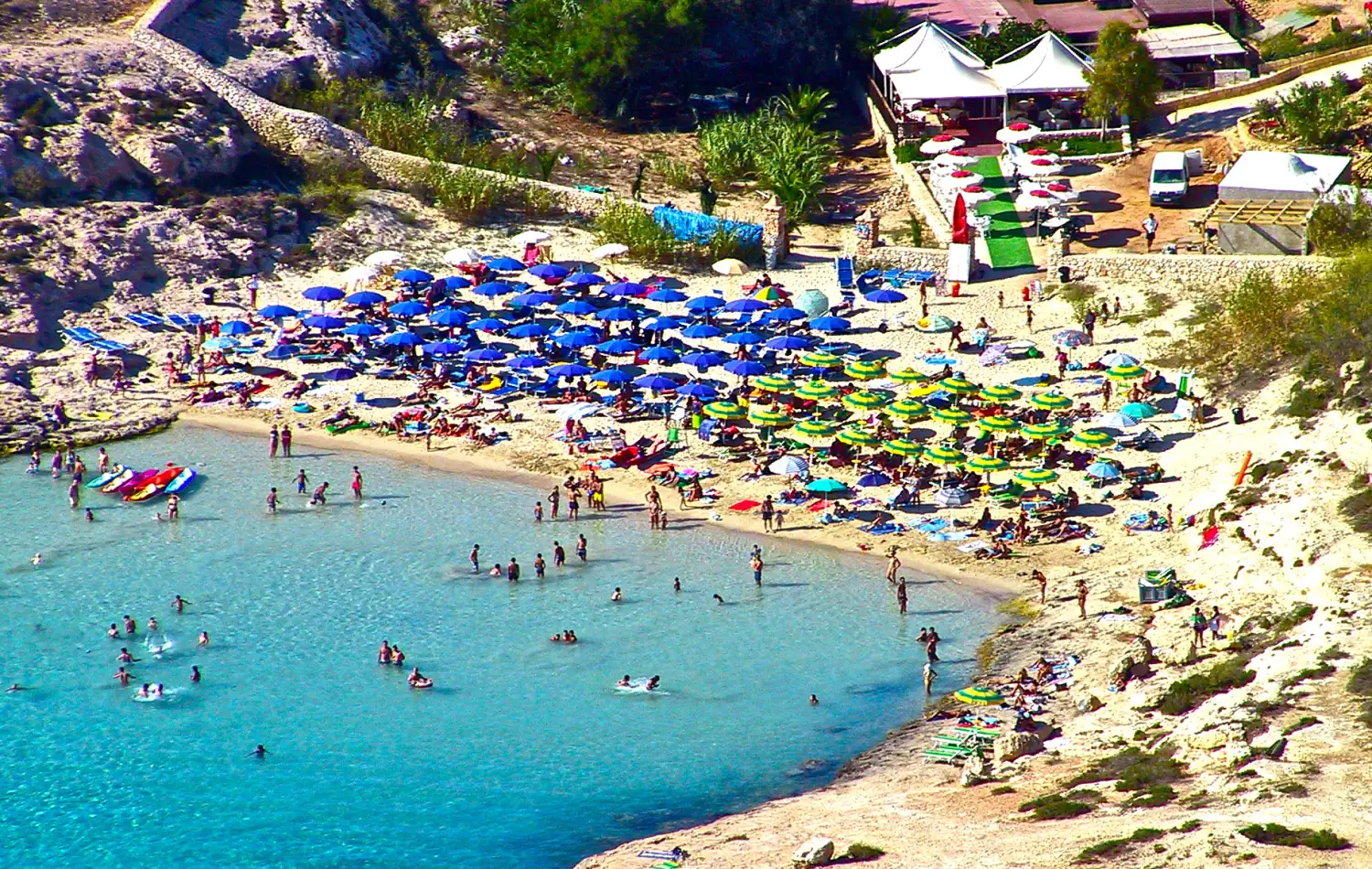
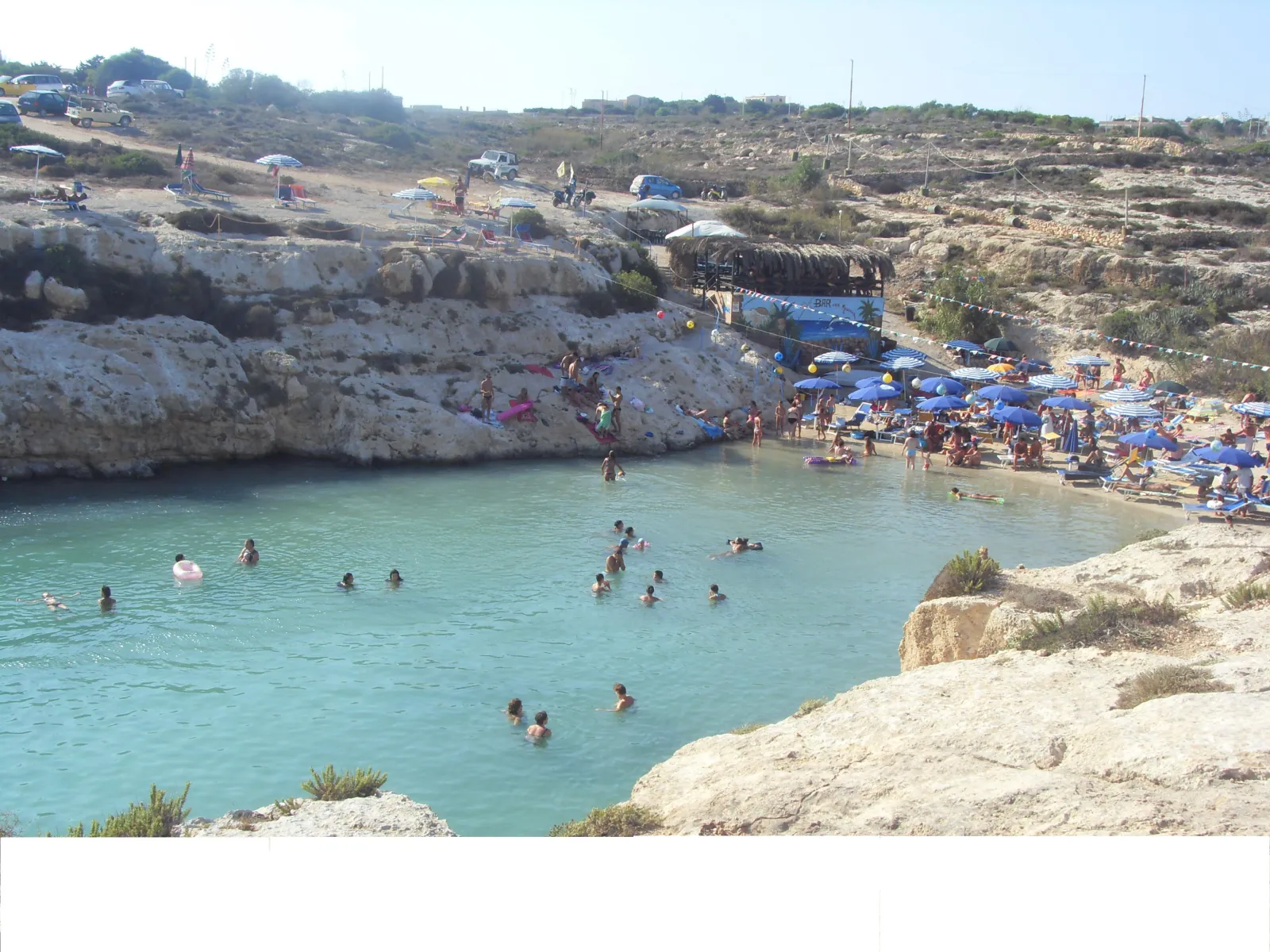
Nearby coves
Frequently asked questions
Is Cala Francese suitable for children?
With some care yes, though it is not the easiest option. The bottom is mixed and rocks break the surface, so reef shoes and constant supervision are needed, and the water gets deep sooner than at Guitgia. There are no facilities and no guaranteed shade. With little ones Cala Madonna or Guitgia work better, keeping Cala Francese for a snorkelling morning with older kids.
Are there kiosks, toilets or sunbeds?
Treat it as having no facilities and plan accordingly, with water, food, an umbrella and a bag for your rubbish. On the island's smaller coves what is available changes from season to season, so do not rely on what you have read elsewhere and check on the spot. Town is not far away if you have forgotten something.
In which wind should I avoid it?
In sirocco (south-easterly), levante (easterly) and southerlies in general, because the sea runs into the inlet, the water turns cloudy and a mask is of little use. It is excellent instead with mistral (north-westerly), tramontana (northerly) and ponente (westerly), which leave it flat. Check the forecast the night before and keep an alternative on the east side ready.
Do I need to book to get in?
No. The compulsory booking with timed entry slots applies to Rabbit Beach, inside the Nature Reserve. Cala Francese is freely accessible at any point in the day. The only practical constraint is parking, which holds few cars and fills up early in August, and that is what really decides what time you should set off.
Can I get there without a car or scooter?
Yes, on foot it is a long walk from the centre along the road skirting the airport, but the route has no shade and is unpleasant in the hottest hours. A bike works too, since the gradient is modest. The most comfortable option remains the scooter, which in high season has to be booked well in advance.