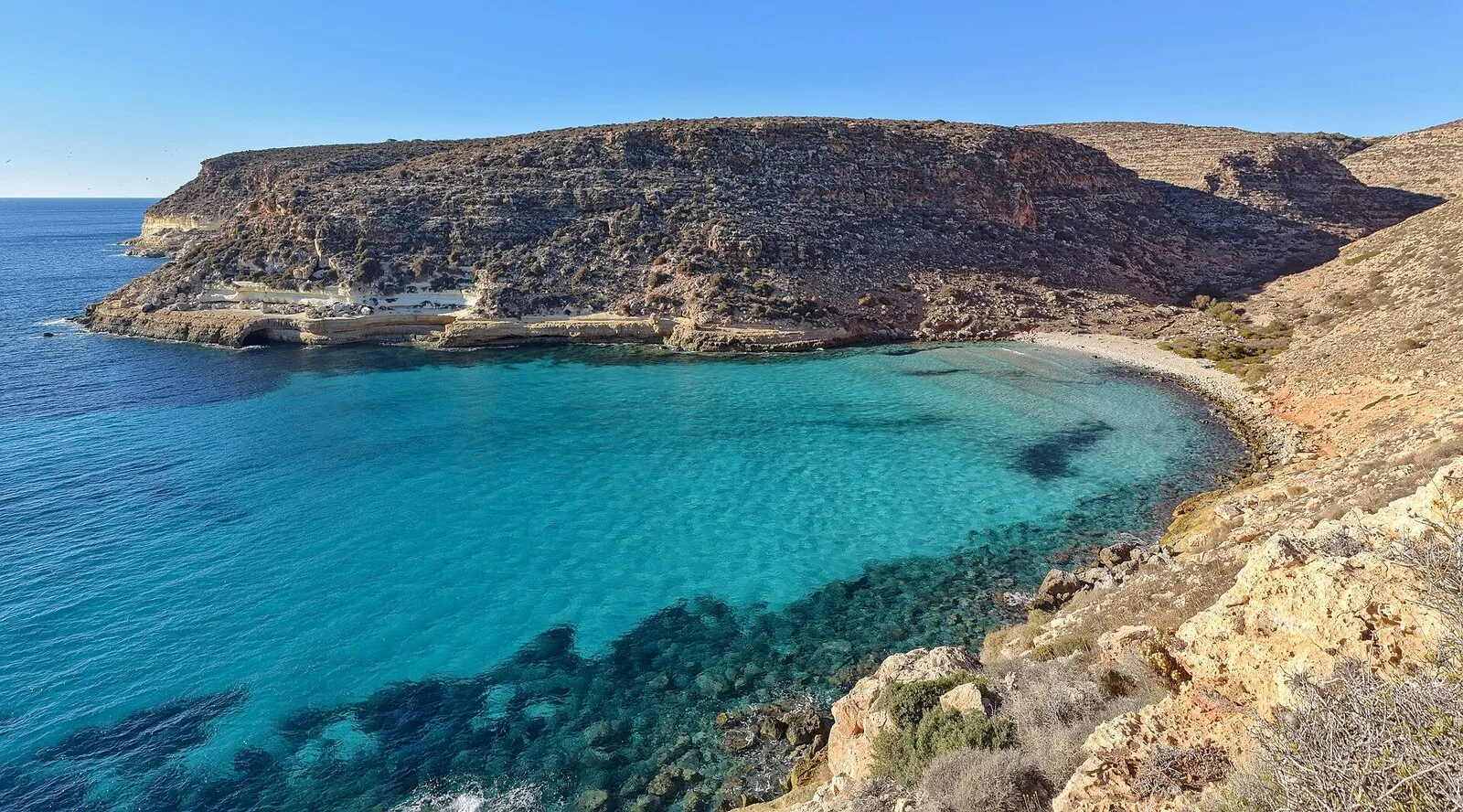
Which beach to choose according to the wind
In Lampedusa you don't pick the beach, the wind picks it for you. With the mistral the south coast works, with the sirocco you move east. Here is the rule, cove by cove.
Why the wind decides everything in Lampedusa
Lampedusa is small and low: about twenty square kilometres, with a highest point, Albero Sole, that reaches 133 metres on the north-west coast. Nothing here stops the wind, and the shape of the island, stretched from east to west, does the rest. What happens on the south side and what happens on the north side are two different days, ten minutes apart by scooter.
Geography matters more than temperature. The south coast is made of sand and low coves and faces Africa: when the wind comes from the south-east it takes the swell head on. The north coast is a wall of cliffs with no beaches reachable on foot, so it is not an option for your towel, but it is the barrier that shelters the south when the wind blows from the north-west. The east side, around Cala Pisana and Cala Creta, is the island's classic plan B.
How to read the forecast the night before
The right habit is to check the wind in the evening for the next day. You need three numbers, and the first one matters more than the other two.
- Direction. This is what decides the beach. Apps give it in degrees or by quadrant: 315 degrees is north-west, the mistral, 135 degrees is south-east, the sirocco. The direction tells you where the wind comes from, not where it is going.
- Strength, in knots. Below 10 knots little changes. Between 10 and 18 knots the difference between the sheltered and the exposed side is very clear. Above 20 knots it is no longer a choice.
- Gusts. The peak is what sends your umbrella flying and cancels boat trips. Always look at the gust, not just the average.
Apps like Windfinder or Windy do the job, and they are the ones you will see open on phones down at the harbour. Don't fixate on strength: a moderate wind from the right quadrant leaves you a postcard sea, while a few knots from the wrong quadrant are enough to ruffle a cove and cloud the water near the shore.
The thirty second rule
Open the app, read the direction and ask yourself which way the cove you are heading to faces. If the wind comes from that same side, change cove. That is ninety per cent of the job.
With the mistral, head south
The mistral (north-westerly) is the island's favourite wind: cool, dry, it clears the air and drops the humidity. It arrives on the cliff side, which acts as a wall, so along the south coast the sea stays flat even when you can clearly feel the wind up on the headlands. These are the days when the water is at its clearest and you can see a long way.
- Guitgia and Cala Madonna, a short walk from town, sand and shallow water.
- Cala Croce, white sand and shallow water close to the shore.
- Cala Maluk, small and quiet, along the airport road.
- Cala Francese, a secluded inlet to the south-east, excellent for snorkelling when the sea is still.
- Rabbit Beach, on the south-western side. Cala Pulcino, on the same side, can only be seen from the sea.
- The island boat tour with a stop at Tabaccara: this is the right day for it.
If you only have one good day and the forecast says mistral, spend it on the open sea: boat in the morning, a southern cove in the afternoon. With this wind Tabaccara and the caves of the north coast are at their best.
With the sirocco, move east
The sirocco (south-easterly) comes in warm and humid, and brings a sticky closeness with it. It raises the sea along the whole south coast, from Punta Sottile to Capo Ponente, and cuts underwater visibility, because the sand lifted by the swell clouds the first few metres and snorkelling from the shore gives you little. On days of strong sirocco even the air turns milky and the horizon disappears.
- Cala Pisana, on the east side, very close to town, sand and rock with a shallow bottom.
- Cala Creta, also east, rocks and deep water straight away, with the richest seabed you can reach from the shore.
- Mare Morto, which many call Cala Calandra, on the north-east: a generally calm bay, good for swimming and snorkelling.
- West and north generally stay calm, but they offer no beaches you can reach on foot: they count for those going out by boat, conditions permitting.
What to avoid with the sirocco is the whole southern strip: Rabbit Beach, Cala Pulcino, Cala Croce and Guitgia can be choppy and cloudy exactly in the middle of the day. If you already have your Rabbit Beach booking you can still go, but expect a swim rather different from the one in the photographs.
The other winds in brief
The mistral and the sirocco cover most days, but not all of them. What follows holds in general: the shape of a single cove can always prove it wrong, so look at the sea before you lay out your towel.
- Tramontana (northerly). It behaves like the mistral, with the south coast sheltered and the north side taking the brunt. It brings colder air: in spring or autumn a day at the beach can turn windy even with a calm sea.
- Libeccio (south-westerly). It complicates precisely the south-western sector, so Rabbit Beach, Cala Pulcino and Tabaccara can pick up a long swell. Better to move east.
- Ponente (westerly). An in-between effect: the south-facing coves generally hold up, while the stretch towards Capo Ponente gets moving. It is often a breeze that builds in the afternoon.
- Levante (easterly). The opposite of the sirocco: it makes life hard at Cala Pisana and Cala Creta and leaves the coves near town calmer.
The full cove by cove table
Keep this table next to the forecast. It describes moderate winds: when the wind is strong the differences grow, and some coves simply become unusable.
| Cove | Side | With mistral (NW) | With sirocco (SE) | Access | Seabed |
|---|---|---|---|---|---|
| Guitgia | South, in town | Sheltered, calm sea | Exposed, often choppy | On foot from the centre | Fine sand, shallow |
| Cala Croce | South, near town | Sheltered, calm sea | Exposed, rough sea | Car park at the entrance, short walk down | White sand, shallow near the shore |
| Cala Madonna | South, next to Guitgia | Sheltered, calm sea | Exposed, often choppy | On foot or by car from town | Sand, shallow, good for children |
| Cala Maluk | South-east, along the airport road | Sheltered, calm water | Exposed, rough sea | From land, no facilities | Sand, pebbles and low rock, water shoes help |
| Cala Francese | South-east | Sheltered, excellent for snorkelling | Exposed, cloudy water | Road plus a short stretch over rock | Sand mixed with rock |
| Rabbit Beach | South-west | Sheltered, flat sea | Exposed, rough sea | Booking required plus a path of about 800 m | Sand, very shallow water |
| Cala Pulcino | South-west | Sheltered, turquoise water | Exposed, not advisable | By sea only, access on foot prohibited | Pale bottom, no facilities |
| Tabaccara (sea only) | South-west | Calm, a fixed stop on boat tours | Swell, often skipped | By sea only | Rock and pale sand, superb snorkelling |
| Cala Pisana | East | Usually fine | Sheltered, calm sea | Close to the centre, car or scooter | Sand and rock, shallow near the shore |
| Cala Creta | East | Usually fine | Sheltered, calm sea | Easy access from the rocks | Rock, deep water straight away |
| Mare Morto / Cala Calandra | North-east | Generally calm | Sheltered, calm sea | Short stretch from land | Rocky, very good for snorkelling |
When the wind is strong
Above a certain threshold it is no longer about picking the right cove: the whole day changes. Boat trips get cancelled, and that is not the operator being difficult but a decision taken in the morning after looking at the sea. The hydrofoil from Porto Empedocle is dropped when the sea is rough, while the ferry copes better: if you have a departure booked on a windy day, check the sailings before heading to the harbour.
You booked Rabbit Beach on a sirocco day
The Rabbit Beach booking is tied to your time slot and you cannot move it because of the weather. You can still go: the place stays extraordinary even with a rough sea, and the path is the same. Just expect swell near the shore, less clear water and very little shade. If the wind is really strong, use your slot for the view and save the swim for the east side.
One last practical note. Strong wind here is not only a sea problem: umbrellas that won't stay put, flying sand, exposed paths such as the one down to Rabbit Beach that become hard work under gusts. On days like that the island is better explored on land, between the town, the Sanctuary of the Madonna di Porto Salvo and the Porta d'Europa.
Frequently asked questions
How much wind is too much?
There is no official threshold, but there is a practical rule of thumb. Below 10 knots go wherever you like. Between 10 and 18 knots pick the sheltered side and you will be fine. Above 20 knots, with higher gusts, even the sheltered side gets uncomfortable and boat trips are almost always off. Direction matters more than strength, but past a certain point strength takes over.
Does the mistral bring cold weather?
It brings cooler, drier air, which in high summer is a relief: it drops the humidity and makes the nights bearable. On the beach, on the sheltered side, you barely feel it. It is different in May, early June or in autumn, when a day of stiff mistral calls for a sweatshirt in the evening, especially on exposed headlands such as Albero Sole or Capo Ponente.
Can you swim when the sirocco blows?
Yes, by changing sides. On the east side, at Cala Pisana, Cala Creta and Mare Morto, the sea usually stays orderly and you swim well. On the south coast you find swell near the shore and water clouded by lifted sand: you can still get in, but it is not the Lampedusa of the photographs and snorkelling gives you little.
Which beach always works?
None of them works with every wind, and that is the whole point of this guide. The most versatile are the eastern ones, Cala Pisana and Cala Creta, because they handle the sirocco and generally cope with the mistral too. If you need one answer for an uncertain day start there, then look at the sea when you arrive before unloading everything off the scooter.
Does the wind change during the day?
Often it does. In the morning the sea tends to be stiller and in the afternoon the breeze builds, so a cove that is perfect at nine can be ruffled by four. That is why it pays to snorkel and go out by boat early, and to keep the afternoon for a sheltered cove or for the town. If you have a crossing booked, check the forecast again at midday.
Read more
Once you have chosen the side of the island, the rest follows.
Boat tours and mistral days
With a north-westerly the sea to the south stays flat and the island tour is at its best, between Tabaccara, Rabbit Island and the caves of the north coast. If the forecast looks good, book your tour for that day.