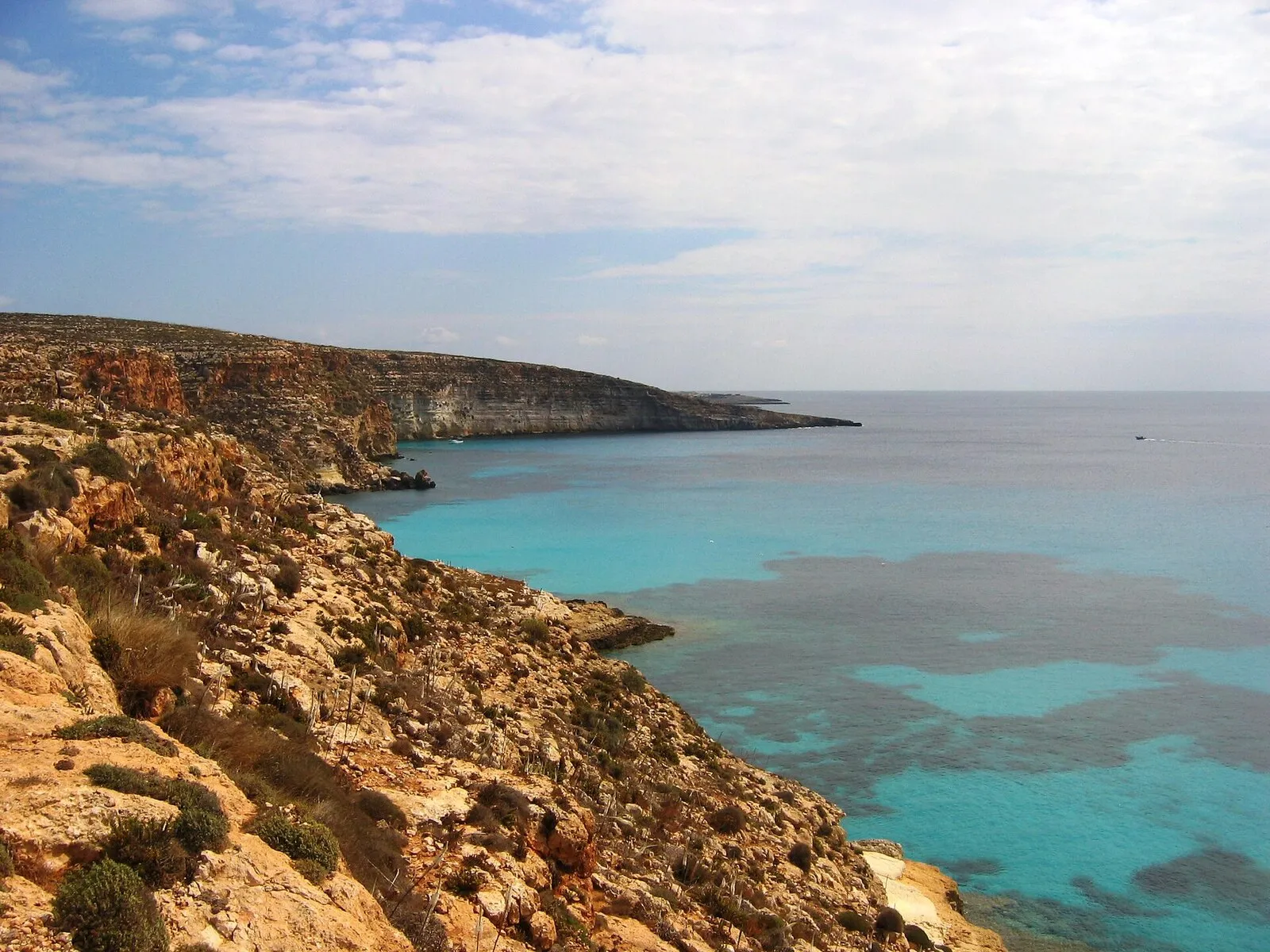
Snorkeling in Lampedusa, where and how
Mask, snorkel and a few metres of water. In Lampedusa the best seabeds start right below the shore: here are the spots you can reach on foot, the ones you only see from a boat, and the rules of the Marine Protected Area.
Why Lampedusa is made for snorkeling
Lampedusa is a limestone plateau that drops into the sea with no rivers and very little fine sand in suspension. You notice it the moment you put your face in the water: long visibility, light reaching the bottom even at eight or ten metres, sharp outlines. And you do not need a boat to find an interesting seabed, because the rock often starts a few metres from the shoreline.
- Clear water for most of the season, above all with the mistral, which keeps the sea flat on the southern side.
- Rocky bottoms and Posidonia meadows close to shore, so the life is concentrated where you can swim to.
- Part of the sea belongs to the Isole Pelagie Marine Protected Area, and in the protected zones the fish are bigger and far less shy.
- Small sheltered coves: if one side is rough, you will almost always find a calm one on the other side of the island.
The scale of the island matters too: just over twenty square kilometres, a few minutes from town to Cala Creta, a quarter of an hour to Capo Ponente. You decide where to get in the water on the morning itself, looking at where the wind blows, and you can change your mind in the afternoon without losing the day.
The rules of the Isole Pelagie Marine Protected Area
The sea around Lampedusa, Linosa and Lampione is part of the Isole Pelagie Marine Protected Area, managed by the municipality of Lampedusa e Linosa. Protection is not uniform: the perimeter is split into three zones, and knowing which one you are in changes what you may do.
- Zone A, full reserve. The sea north of Capo Grecale, the stretch in front of Rabbit Island and the strip north of Linosa. Maximum protection and no swimming, with one well known exception, Rabbit Beach.
- Zone B, general reserve. Activities are allowed but regulated, and some need authorisation from the managing body. Swimming and snorkeling are among the permitted ones.
- Zone C, partial reserve. The buffer strip towards the open sea, where low impact activities are allowed, snorkeling included.
Wherever you are, three bans apply regardless of the zone.
- Do not touch and do not collect anything, neither living organisms nor shells or pieces of rock.
- Do not anchor on Posidonia: the meadow is a protected habitat and an anchor tears it up in seconds.
- Do not feed the fish, because it changes their behaviour and makes them depend on swimmers.
Zone A, you may look but not swim
If you move on your own with a small boat, or follow the coast swimming, keep in mind that in zone A swimming is forbidden and fines do exist. The water in front of Rabbit Island is zone A and the beach is the only exception.
Detailed rules change over time and can be tightened by seasonal orders. Before you leave, check the official website of the Marine Protected Area and read the signs at the access points, which carry the version in force.
The spots you reach from shore
Here you park, walk down and swim. The table gives the side of the island for each spot, which is the piece of information that can save your day: with the sirocco the southern side turns rough and murky, with the mistral it is the best side of the island.
| Spot | Side | Access | Seabed | Level | Best wind |
|---|---|---|---|---|---|
| Cala Creta | East | Off the rocks, easy entry | Rock, deep straight away | Intermediate | Sirocco |
| Mare Morto (Cala Calandra) | North east | From the rocky shore | Rocky, sheltered bay | Easy | Sirocco |
| Cala Pisana | East | Sand and rock, comfortable | Shallow and sandy, then rock | Easy | Sirocco |
| Cala Francese | South east | Secluded inlet | Sand mixed with rock | Intermediate | Mistral |
| Rabbit Beach | South west | 800 m path, booked time slots | Shallow sand, rock towards the islet | Easy | Mistral |
| Cala Croce | South | Car park at the entrance, close to town | Shallow and sandy, rock on the sides | Easy | Mistral |
| Guitgia | South | On foot from town | Sandy and shallow | Easy | Mistral |
Two warnings. Cala Pulcino is no longer a spot you reach from shore, because access by land is prohibited and the path that used to go down the valley is closed for rockfall risk: you only see that seabed from a boat. If you want an alternative from shore, head for Cala Creta, Mare Morto or Cala Francese. Rabbit Beach in season is visited on two shifts, morning and afternoon, with a free but compulsory online booking and a limited number of entries; check slots and rules on the reserve website before you travel. In the water, stay in the marked usable stretch.
The spots you only see from the sea
The northern coast is a wall of cliffs and has no beach reachable by land. To the south west there are coves with no path either. Those are exactly the places with the best water, and the only way to put a mask in them is to arrive floating.
- Tabaccara. South west, only by sea: one of the bluest stretches of the island and a fixed stop of the boat tours, with a pale bottom that reflects the light.
- Cala Pulcino. South west, only by sea: access by land is prohibited and the valley path is closed because of rockfall risk, but from the boat it is still one of the finest seabeds on the island.
- North coast, caves and cliffs. Sheer walls, arches and sea caves, deep water right under the boat. Usually included in the island tour.
- The open side of the Rabbit islet. You see it from the boat during the stop in front of the reserve. Remember it is zone A and the rules in the water are strict.
- Lampione. An isolated rock to the west, seabeds for experienced divers and a dedicated trip: not a place for improvised snorkeling.
That is why the boat tour is not a tourist extra but the missing piece: in half a day you cover the spots that do not exist from land. Strong wind cancels the trips, so book yours early in your stay and keep a spare day.
What you see underwater
Do not expect a coral reef: what you find is a Mediterranean in good health, which is a different and rarer thing. On the rock, between three and ten metres, these are the most common encounters.
- White seabream and saddled seabream in small groups, often mid water above the rock.
- Dark damselfish, moving like a cloud when there is a current.
- Rainbow wrasse, colourful, curious and very fast, almost everywhere on mixed bottoms.
- Octopus hidden in their dens, given away by the shells piled at the entrance.
- Groupers in the more protected zones, still in the shade of an outcrop.
- Posidonia meadows, which are not algae or dirt but a marine plant, a sign of healthy water.
Caretta caretta turtles are here and they nest on the island, but meeting one while snorkeling from shore is rare: you are far more likely to see one surfacing during a boat trip. If you do find one, do not chase it and do not touch it.
Gear and safety
You need little, but that little has to work.
- A mask that seals without a tight strap: try it dry, it should stay on your face with a single breath in.
- A simple snorkel and short fins, more than enough close to shore.
- A marker buoy if you move away from the shore or the boat: in Italy it is compulsory, you stay within fifty metres of it and boats must keep one hundred metres away.
- A long sleeved rash guard or a t-shirt: your back stays in the sun for hours and burns without you noticing.
- Reef shoes for rocky entries, which here are the majority.
- Water and a hat for afterwards, because there is very little shade on the island.
The right time of day
Get in the water early in the morning. The sea is calmer, the thermal wind has not picked up yet, the light lifts the colours and there are fewer boats at anchor. In the afternoon visibility almost always drops.
On safety, three rules count more than the others: never go alone, watch the current along the headlands and at the edges of the coves, and never cross the middle of an anchorage, because on the surface you are nearly invisible to anyone manoeuvring. If you also plan to dive, there is a hyperbaric chamber on the island.
If the wind turns, change the spot
The island rule applies underwater too: the wind decides where you get in. With the mistral from the north west the sea stays flat to the south and south west, so Cala Croce, Guitgia, Cala Francese and Rabbit Beach are at their best. With the sirocco from the south east the southern side picks up and turns murky, and you move east and north east, to Cala Pisana, Cala Creta and Mare Morto.
The full beach by beach breakdown is here: Beaches by wind
Frequently asked questions
Do I need a permit to snorkel in the Marine Protected Area?
No. For snorkeling in zones B and C no individual permit is needed, you just follow the rules: no collecting, no anchoring on Posidonia, no feeding the fish. Zone A stays closed to swimming, and organised activities need authorisation from the managing body.
Can I snorkel at Rabbit Beach?
Yes, it is the exception that allows swimming inside a zone A. In season, though, access runs on two shifts with compulsory online booking and limited places, and in the water you must stay in the marked stretch. The bottom off the shore is shallow and sandy.
What is the best spot from shore?
If you want a single address, Cala Creta: easy entry off the rocks, deep water straight away and some of the finest seabeds on the island a few metres from the shoreline. With the mistral, instead, move your mask to Cala Francese or Rabbit Beach. Cala Pulcino, which many guides still list, can no longer be reached on foot: the path is closed and you only see it from the sea.
Is it suitable for children?
Yes, if you pick the place. Guitgia, Cala Croce and Cala Pisana have shallow sandy bottoms close to shore, ideal for first times with a mask. Better to avoid entries off the rocks and exposed coves, and always put on a rash guard against the sun.
Can you see the turtles?
From shore it is rare. Lampedusa is a nesting site and turtles do use these waters, but sightings almost always happen offshore, during boat trips. The island also has a first aid centre for sea turtles, hosted in the premises of the Marine Protected Area.
Read more
Tabaccara and the north coast, you get there by boat
The best spots on the island have no path: you reach them by sea, on the trips that leave the harbour in the morning.