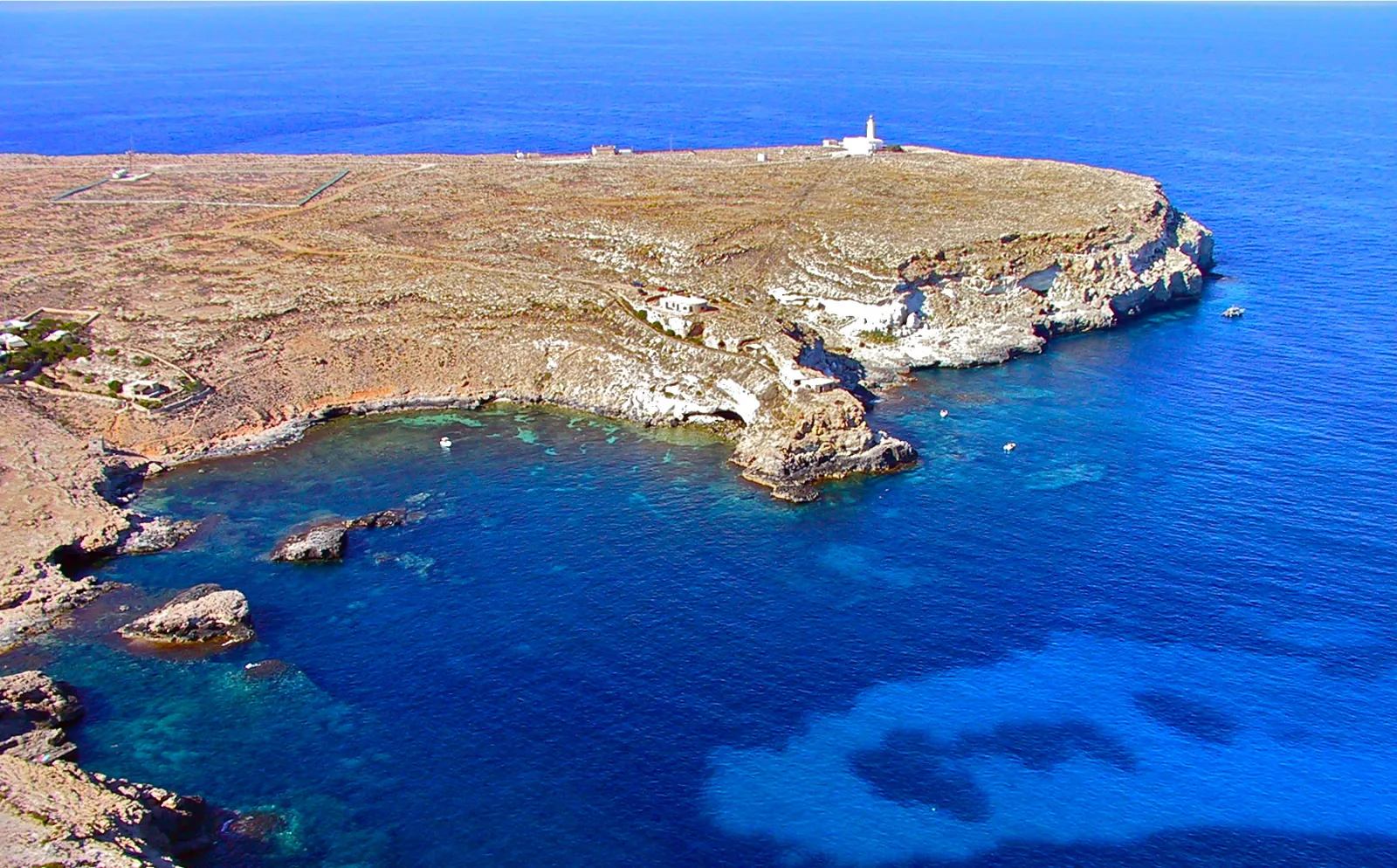
Mare Morto, rock and still water below Capo Grecale
Also known as Cala Calandra, it stays calm when a southerly is churning up the rest of the island. No sand at all, only rock, and a seabed that rewards anyone carrying a mask.
Tomorrow: sirocco (south-easterly) 8 knots. This cove is sheltered, the sea should be calm. Full wind guide
Mare Morto sits on the north-east side of the island, outside town and just below the Capo Grecale lighthouse. Maps also call it Cala Calandra, but everyone uses the other name, which describes exactly what you see, a sheet of water lying still while the rest of the coast moves. This is not a beach but a fold of pale rock, with boulders breaking the surface a few metres out and a colour that turns deep blue the moment the bottom drops away.
Anyone turning up in search of sand is disappointed within seconds. There is no sand, no kiosk, not a metre of shade, so you spread your towel on rock and get in from a natural step. In return you get a seabed falling away over boulders and crevices a few strokes out, and a stillness you will not find anywhere else on a sirocco day. It is the cove for people who come to swim and look underwater.
| Access | by car or scooter |
|---|---|
| Distance | 3 km from town, 40 minutes on foot |
| Seabed | rock |
| Depth | medium |
| Shade | none |
| Facilities | none |
| Parking | limited |
| With children | with care |
| Snorkeling | among the best on the island |
| Sheltered from | southerly (ostro), south-westerly (libeccio), westerly (ponente), sirocco (south-easterly) |
| Exposed to | northerly (tramontana), north-easterly (grecale), easterly (levante) |
Getting there
- From town take the road towards the Capo Grecale lighthouse, heading north-east, a few minutes by scooter.
- Shortly after the turning for Cala Creta, bear right and follow the narrow lane running down towards the sea.
- Leave your vehicle on the dirt clearing at the end, where spaces are few and nobody is watching, so leave nothing visible inside.
- Carry on for about a hundred metres on foot over rock and loose stones, as far as the first platforms above the bay.
- In summer a town bus route usually passes through this area, but ask locally for the stop and the last service back.
Why the water here stays flat
The bay is set deep into the coast and shielded from behind by the headland of Capo Grecale. The winds that rule a Lampedusa summer come mostly from the south or the west, and from those sectors no swell builds here. In a sirocco (south-easterly), which piles up water along the whole southern shore and ruins visibility, Mare Morto stays flat and clear, which is why the nickname replaced Cala Calandra in everyday speech.
The flip side is that the wrong wind switches it off. When it swings round to tramontana (northerly), grecale (north-easterly) or levante (easterly), the swell drives straight into the inlet and the bay becomes one of the worst places on the island for a swim. Check the forecast the evening before and think in wind sectors, not whole days, because the morning that ruins the south coast makes this side perfect. In a mistral (north-westerly) the water here usually stays readable, but the south side is better.
Getting in, and what you need on your feet
There is no single entry point, the rock steps down in ledges and everyone picks their own. Look for a dry, rough step and avoid slabs covered in brown algae, as slippery as soap. Reef shoes are not a suggestion here, they are the minimum kit, both for the sea urchins and for climbing back out, the awkward part with wet hands. Look below before you jump in, because a few metres out there are boulders invisible from above.
What you see with a mask and snorkel
Ten metres are enough to understand why people come to Lampedusa to get underwater. The bottom is a run of boulders, fissures and small caves, with shoals of damselfish, sea bream and wrasse, and the odd fish in a hole. Further out you can make out islets and a rock arch, and the depth increases gradually. Marine Protected Area rules apply in full: touch nothing, collect nothing, never feed the fish and keep off the posidonia.
The lighthouse, the sunrise and the complete lack of facilities
A little further up, on the headland, stands the Capo Grecale lighthouse, the place on the island where people go for sunrise and the best reason to plan your morning here. For everything else keep expectations at zero, because you will find no bar, no sunbeds, no toilets, no showers and no natural shade beyond the short strip a rock face offers early on. Bring water for everyone, something to eat and a bag for your rubbish.
Come early and leave early
The good window runs from sunrise to about ten, when the water is calmest, the low light lets you read the seabed, the rock is not yet scorching and parking is still free. By midday, without a centimetre of shade, the same cove turns into hard work.
When to stay away
With wind from the north, north-east or east the bay loses the name it carries, the swell drives straight in, wet rock turns slippery and getting out becomes the risky part. On those days move your swim to the south side. Remember too that Zone A of the Marine Protected Area begins beyond Capo Grecale, where swimming is not allowed.
Where Mare Morto is
Nearby coves
Frequently asked questions
Why is it called Mare Morto
Because in the conditions you get most often in summer the water in the bay sits almost motionless, sheltered from southerly winds and screened from behind by the headland of Capo Grecale. Charts show the same cove as Cala Calandra, but hardly anyone on the island uses that name. It does not mean the water is always calm, since a northerly stirs it up thoroughly.
Is Mare Morto suitable for children
It depends on their age and how confident they are in the water. There is no sand to play on, you get in over uneven rock and the depth builds quickly, so it is not the place for a two or three year old. With older children who swim well and have a mask and reef shoes, it becomes one of the most entertaining coves on the island.
Do I really need reef shoes
Yes, pack them before you travel. There is not a metre of sand here, you walk on bare rock that is often slippery with algae wherever it is wet, and sea urchins are common in the crevices just below the surface. Sea sandals or neoprene booties both work, as long as they stay on your feet while you swim.
Are there bars, sunbeds or toilets
No, none of that. Mare Morto is a free cove with no facilities at all, so no kiosk, no rentals, no public toilets and no shade. Parking is a dirt clearing with only a handful of spaces. Plan it as a self-sufficient half day, with plenty of water, a hat, sunscreen, a thick towel for the rock and a bag for your rubbish.
Can you snorkel and dive here
That is one of the main reasons to come. From the shore, with mask and snorkel, you have boulders, fissures and small caves within a few metres. The area is also popular for scuba diving, although trips are organised from the harbour rather than from the cove itself. The island has a hyperbaric chamber, a detail divers tend to appreciate.