Culture and landmarks to see in Lampedusa
Lampedusa is not only about the sea. It is a frontier island of history, faith, memory and encounters, with places that tell of its spot in the middle of the Mediterranean. Here is what to see when you leave the beach for a few hours.
A crossroads island, not just a beach
Lampedusa is the southernmost tip of Italy, closer to Tunisia than to Sicily. It is politically Italian, but geologically it belongs to the African plate: you can tell from the low, bare limestone rock, so different from nearby volcanic Linosa. This position, almost at the centre of the basin, has always made the island a passage point between Europe and Africa.
Permanent settlement is recent: it dates to 1843, when the Bourbons established the first community here. Before that these were mostly stopovers for fishermen, corsairs and sailors. Understanding this history helps you read the island beyond the postcard, and makes sense of the places that follow.
The Porta d'Europa
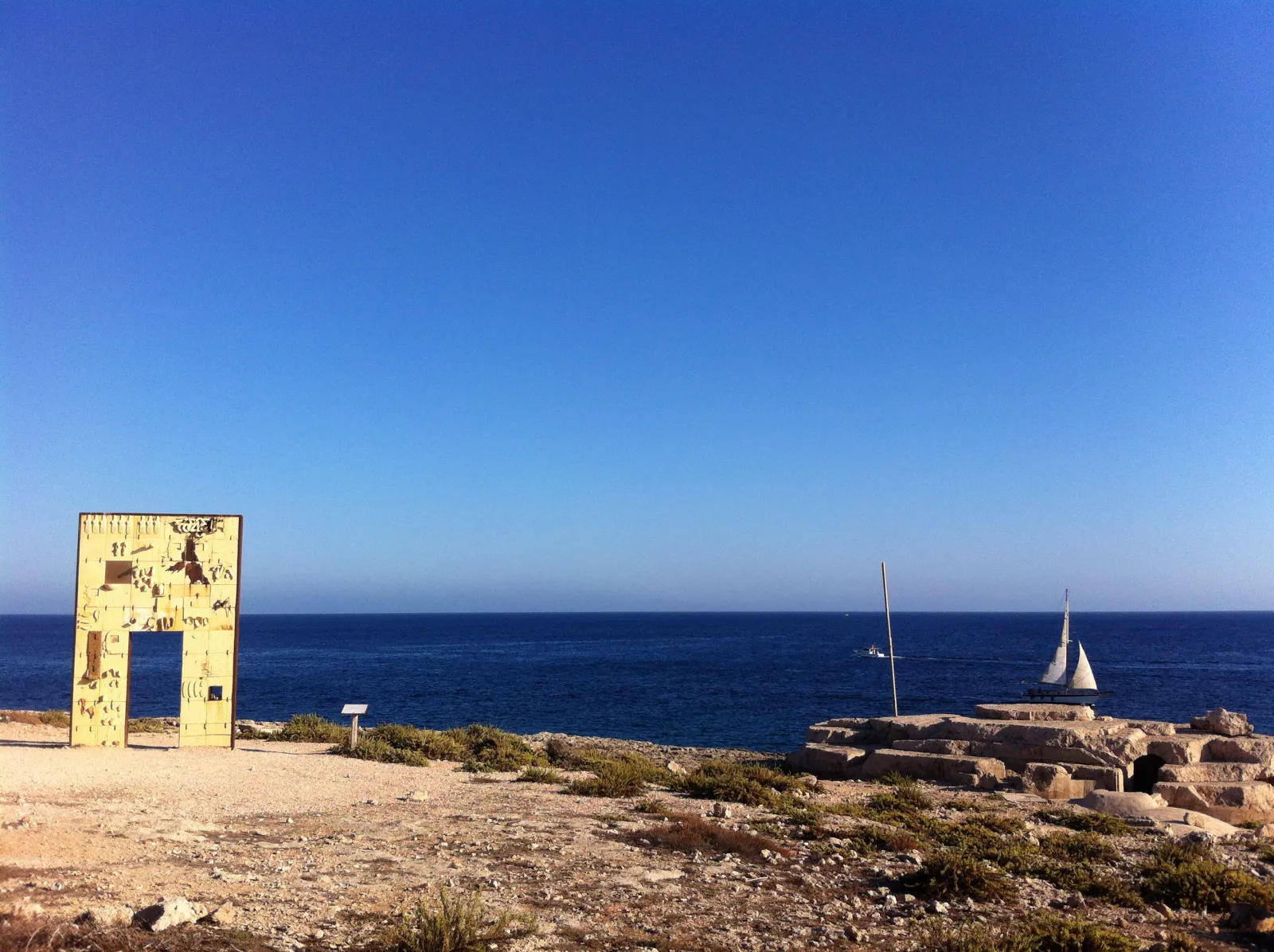
On the cliff of the western side, far from the town and facing the open sea towards Africa, stands the Porta d'Europa. It is a monument almost five metres tall, in warm-coloured refractory ceramic and iron, created by the artist Mimmo Paladino and unveiled in June 2008 on the initiative of the Amani organisation.
It is not a gate you walk through, but a symbol. It is dedicated to the memory of the people who died at sea trying to reach Europe. It is easy to reach and open at any hour, free of charge: the most intense moment is sunset, when the light sets the ceramic aglow and there is only the horizon in front of you. More than any other spot, it explains why Lampedusa became a name everyone knows.
The Madonna di Porto Salvo sanctuary
Inland, in a green hollow sheltered from the wind, lies the sanctuary of the Madonna di Porto Salvo, the island's religious heart. It is a small church partly carved into the rock, surrounded by a garden and caves that once sheltered sailors and hermits. A simple, quiet place, worth a visit even if you are not a believer.
The patron saint's feast is on 22 September, but the celebrations begin in early September. The statue is carried on the shoulders of fishermen from the sanctuary to the Mother Church, and during the feast several processions take place, including one at sea with the island's boats. It is the most heartfelt event of the year and shows the deep bond between Lampedusa and its sea.
The Pelagie Archaeological Museum
In the town you will find the Pelagie Archaeological Museum, reopened in 2024 as the Museum of Trust and Dialogue for the Mediterranean. It tells the ancient settlement of the archipelago through finds and evidence, conveying the idea of an island that has always been a crossroads of stories, peoples and routes.
It is a short visit, suitable for children too, perfect for a windy day or a late afternoon. Opening hours change with the season and with the work under way, so it is worth checking before turning up.
The dammusi and the Via Roma stroll
Wandering the countryside you notice low stone buildings, the dammusi: traditional houses with thick walls and vaulted roofs, made to withstand sun and wind. Many have been restored and now host visitors who rent a place on the island, but they remain a piece of the Lampedusan landscape's identity.
In the evening life moves into the town, along Via Roma. It is the island's promenade, closed to traffic, among shops, ice-cream parlours, restaurants and people meeting. It is not a monument, but it is living culture: the simplest way to feel the rhythm of Lampedusa after sunset.
O'Scià, the festival this guide is named after
Between 2003 and 2012 Lampedusa hosted, every year in late summer, the O'Scià festival, conceived by the singer-songwriter Claudio Baglioni. For a decade it brought live music to the island and put the spotlight on migration and tragedies at sea, long before it became daily news.
The name comes from the local dialect: "oscià" is an affectionate expression, something like "my breath", "my love". This is where this guide takes its name, as a small tribute to an island that welcomes. The festival is no longer held, but it remains part of Lampedusa's recent memory.
Lampedusa's cultural places at a glance
| Place | What it is | Where and when |
|---|---|---|
| Porta d'Europa | Monument by Mimmo Paladino, memorial to migrants. | Western-side cliff, outdoors, always accessible. |
| Porto Salvo sanctuary | Small church in the rock within a garden, with caves. | Inland, feast on 22 September. |
| Pelagie Museum | Finds on the ancient settlement of the archipelago. | In the town, seasonal hours to check. |
| Dammusi | Traditional stone houses of the countryside. | Scattered across the island, many now rentals. |
| Via Roma | The town's evening promenade. | Centre, after sunset. |
| O'Scià | Claudio Baglioni's festival between 2003 and 2012. | No longer active, gives this guide its name. |
When to make time for culture
You need not give up the sea. Keep the cultural places for a windy day, when the beach is less inviting, or for a late afternoon after your swim. Half a day is enough to pair a landmark with a stroll in the town.
How to experience the cultural side of Lampedusa
These are scattered, informal places, not a museum circuit. The best approach is to weave one or two into the rhythm of your holiday, without rushing.
- Go to the Porta d'Europa around sunset: the light on the sea is worth the trip.
- Respect places of worship and memory: quiet, no litter, discreet photos.
- Check the museum hours on site, as they change with the season.
- End the evening on Via Roma, with a granita or a slow walk.
Frequently asked questions
What is there to see in Lampedusa beyond the beaches?
The main places are the Porta d'Europa, the Madonna di Porto Salvo sanctuary, the Pelagie Archaeological Museum, the dammusi scattered in the countryside and the evening stroll along Via Roma. A few hours are enough for a taste of the Lampedusa of history and memory.
Where is the Porta d'Europa and can it be visited?
It is on the cliff of the western side, far from the town and facing the sea towards Africa. It is outdoors, always accessible and free. The best time to go is at sunset.
When is the Madonna di Porto Salvo feast?
The main day is 22 September, but celebrations start in early September and include several processions, one of them at sea with the fishermen's boats.
Is the Pelagie Museum open?
The museum reopened in 2024. Opening hours vary with the season, so it is worth checking on site or on official channels before you go.
Why is this guide called O'scià?
After the O'Scià festival, conceived by Claudio Baglioni and held in Lampedusa from 2003 to 2012. "Oscià" is an affectionate expression in the local dialect, and for us it is a tribute to the island's welcome.
Discovering the island with a guide
Some tours on land and by boat combine the island's landmarks with the story of its history. A good way to go beyond the beach.