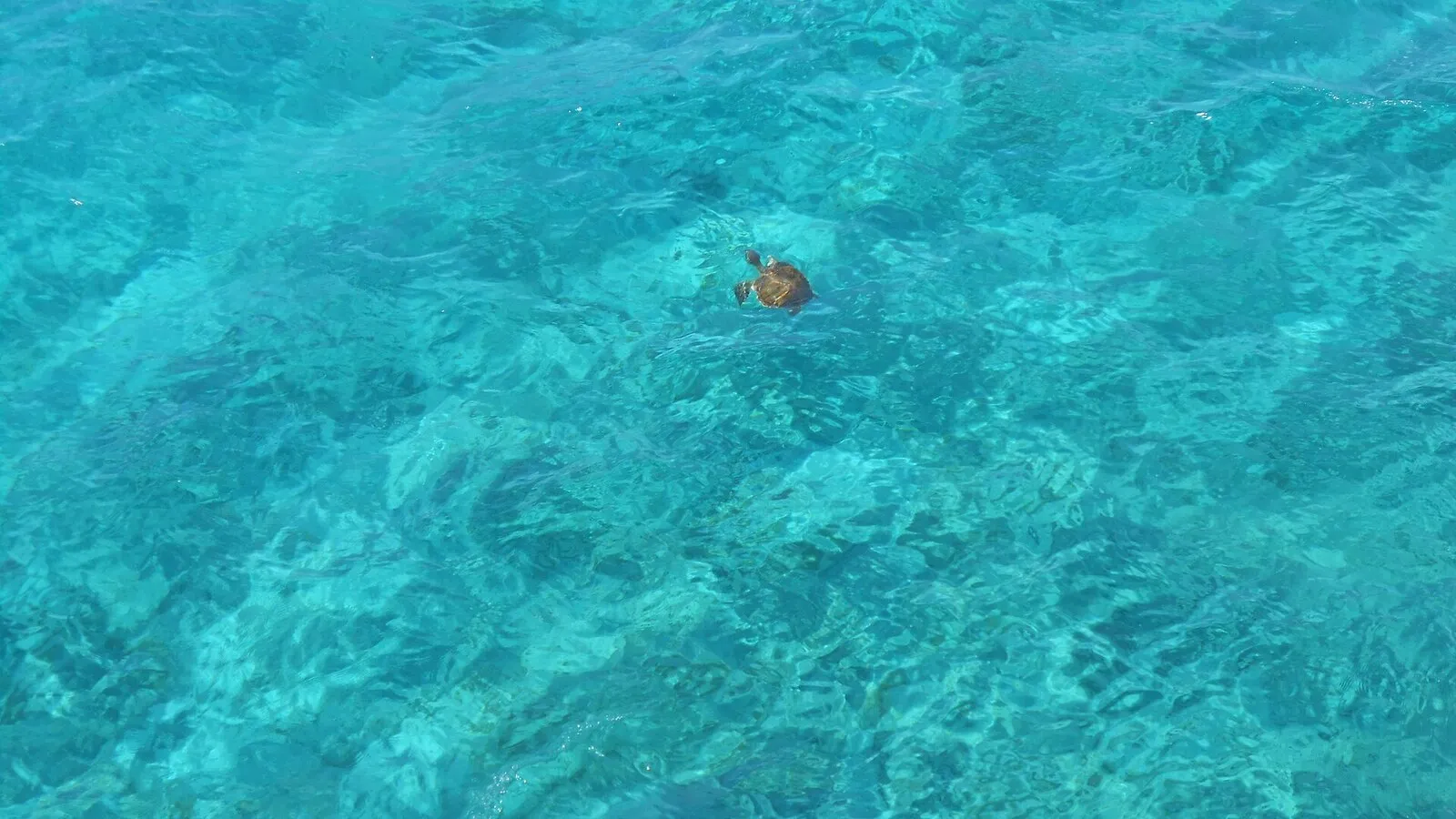
Caretta caretta turtles in Lampedusa
Lampedusa is one of the few places in Italy where the loggerhead sea turtle comes back every summer to lay its eggs. Here is when it happens, how the nests are protected and how to behave so you do no harm.
Why Lampedusa matters for the Caretta caretta
The Caretta caretta swims all across the Mediterranean, but the beaches where it can actually nest are few. It needs the right sand, little artificial light, no night-time traffic and a dry strip wide enough to stay out of reach of the swell. Lampedusa brings those conditions together almost in the middle of the basin, closer to Tunisia than to Sicily.
The emblematic spot is Rabbit Beach, inside the Nature Reserve. Females come up the sand at night, dig a chamber a few tens of centimetres deep, lay their eggs and are back in the water before dawn. Anyone walking past the next morning sees only the tracks, two parallel furrows going up and coming back down. In 2026 the first nest of the season was recorded in late May.
- One of the few Italian sites with regular nesting, not the occasional one-off.
- A position in the middle of the Mediterranean, between Sicily and North Africa.
- Beaches inside a protected area, with monitoring and regulated access.
The calendar, month by month
The season follows a precise rhythm that does not match the holiday one. Nesting and hatching overlap for weeks, so at the height of summer the same beach can hold nests at very different stages.
| Month | What happens | What it means for you |
|---|---|---|
| May | The first females arrive and the first nests may appear towards the end of the month. | Beaches are still quiet. Fences start going up: do not move them. |
| June | Full nesting season, almost always at night and in silence. | No torches or lights on the sand after sunset: a disturbed female turns back to sea without laying. |
| July | Females are still nesting while the first nests hatch, after 45 to 70 days of incubation. | Eggs and hatchlings share the same beach. This is the month when care matters most. |
| August | Last nests are laid and hatchings are frequent, in the busiest period of the year. | Open holes, planted umbrellas and litter become real obstacles for the hatchlings. |
| September | Hatching peaks together with August, while nesting is over. | This is when you are most likely to be near a nest that opens, with fewer people around. |
| October to April | Season closed, no nesting and no hatching. | The beaches rest. Come for the winter sea and the trails, not for the turtles. |
These dates are not a train timetable. They depend on sand temperature and on how the season goes: a warm nest opens earlier, a cooler one takes weeks longer.
Where they nest and how the nests are protected
Once a nest is found, it is marked off with a wooden fence and a sign explaining what lies underneath. The fence is not there to hold the eggs in, it is there to keep feet, umbrellas and onlookers out. The protected area extends around the laying point too, because sand compacted above the nest can crush the eggs or block the hatchlings on their way up.
Monitoring is daily work. At Rabbit Beach it is carried out by the Nature Reserve, managed by Legambiente Sicilia, and by volunteers, as part of a project authorised by the Ministry of the Environment.
- Finding the track and the laying point, usually in the early morning.
- Fencing with a wooden barrier and an information sign, with the surrounding area off limits.
- Counting the days and keeping watch during the expected hatching window.
- Checking the nest after the hatchlings have left, to see how many eggs worked out.
How to behave on the beach
The rules are few and they apply all summer, even where you see no signs. A nest can be there without anyone having found it yet, so the simplest way to help is to behave as if there were one.
Never do this
Lights at night are problem number one. Hatchlings that have just emerged head for the brightest part of the horizon, which in nature is the sea. A torch, a lit screen or a flash sends them the opposite way, inland, where they exhaust themselves.
- No torches, flashes or lit phones on the beach after sunset.
- Do not step inside fenced areas and do not lean on the barriers.
- Do not dig holes, and always fill in the ones you made before leaving.
- Do not plant umbrellas where signs say otherwise: the pole can reach the eggs.
- Take all your litter away, including cigarette butts and bags the wind carries into the water.
- Never touch a hatchling running towards the sea and never help it into the water.
That run across the sand is not wasted time: it lets the hatchling get its muscles going and register the place where it was born. Picking it up, even with the best intentions, takes away something it will need later.
If you find a turtle in trouble
You may come across one stranded, injured, tangled in a fishing line or motionless in shallow water. Even though it feels like the natural thing to do, do not put it back in the sea: if it is weak or injured it may drown. What it needs is a quick call to the people who can collect it.
- Call the Coast Guard straight away on the free number 1530, or alert the rescue centre.
- Do not put it back in the water and do not drag it by the flippers or the shell.
- Give it shade with a towel or an umbrella if it is in direct sun.
- Keep it damp by wetting the shell with sea water, without pouring any into its nostrils.
- Keep your distance, keep dogs and onlookers away and wait for help to arrive.
A photo helps
While you wait, take a photo from a distance and note the exact spot. Knowing the condition of the animal and where it is saves precious time. If it has a hook in its mouth or a line around it, do not pull and do not cut anything yourself.
The first aid and rescue centre
Lampedusa has a first aid and rescue centre for sea turtles, reopened and hosted in the offices of the Isole Pelagie Marine Protected Area. Animals recovered at sea or along the coast arrive here, are treated and, when possible, released back into the wild.
It can be visited by adults and children. Opening hours change with the season and with the work under way, so it is worth checking on site rather than turning up at random. The visit is short and it is worth it if only to see up close how real the threats are.
- Swallowed hooks and lines, often taken for food along with the bait.
- Ingested plastic, from bags to fragments that look like jellyfish.
- Injuries from nets and fishing gear, with flippers trapped or damaged.
How to see them at sea without disturbing them
You cannot book the encounter. Your best chance is on a boat, offshore or in front of the coves, where every so often a turtle comes up to breathe and stays a few seconds at the surface. Snorkelling from the shore, it is rare but not impossible. Either way the rule is the same: you are the one who stops, not the turtle.
- On a boat, cut the engine to idle or switch it off as soon as you see it.
- Do not chase it and do not cut across its path: leave it a clear way offshore.
- Keep your distance and stay quiet, sound travels a long way underwater.
- No contact at all: do not touch it, ride it or hold on to its shell.
- Do not feed it and do not throw anything in the water to draw it closer.
The general rules of the Marine Protected Area apply too: do not collect organisms, do not anchor on posidonia, do not feed the fish. They are the same rules that keep in order the environment the turtles feed in.
The essential biology in a few lines
The Caretta caretta is the most common sea turtle in the Mediterranean. It has a large head and powerful jaws, made for crushing shells. It grows slowly and matures late: a female nesting today has decades of open sea behind her.
| Fact | In short |
|---|---|
| Adult shell length | Generally between 70 and 100 cm, with Mediterranean animals often smaller than Atlantic ones. |
| Adult weight | Roughly from 70 to over 100 kg. |
| Eggs per nest | Around a hundred, laid in a single night. |
| Nests per season | Three to five, about two weeks apart. |
| Incubation | From 45 to 70 days, depending on sand temperature. |
| Sex of the hatchlings | Set by the warmth of the sand: warmer gives more females, cooler more males. |
| Estimated lifespan | Very long, estimated at over seventy years. |
| Beach fidelity | Females tend to come back and nest near the stretch of coast where they were born. |
Almost all the threats are man made. Fishing gear remains the main one, followed by ingested plastic, collisions with boats and artificial lights that disorient both females and hatchlings. In the background there is the warming of the sea and of the sand, which shifts nesting areas and skews the balance between males and females.
Frequently asked questions
When am I most likely to see a hatching?
Between July and September, peaking between August and September, because the eggs open 45 to 70 days after they are laid. It remains an unpredictable event, and it often happens at night or in the early hours of the morning.
Can I watch a hatching?
It is not something you can book and there is no set time. If a hatching happens while you are on the beach, you will be asked to stay behind the marked line, with no lights and no noise. Instructions from volunteers and Reserve staff must be followed to the letter.
Can I take children to the rescue centre?
Yes, the centre can be visited by adults and children. Opening hours change through the season, so check them on site. For younger children it is the most direct way to understand why certain beach rules make sense.
Do sea turtles bite?
They have very strong jaws and can react if they feel cornered or if they are handled. It is not an aggressive animal, but it must not be touched, in the water, on the shore or when it is in trouble.
Why does Rabbit Beach have entry slots?
Because it lies inside a Nature Reserve and holds nests. In recent seasons access has been free but by booking, with one morning slot and one afternoon slot and a maximum number of visitors. Check the current rules on the Reserve website before you travel.
Read more
Looking for them from the sea
The most likely way to see a Caretta caretta in the wild is to spend a few hours on a boat, moving from one cove to the next. No tour can promise an encounter, but time spent offshore is what counts most.