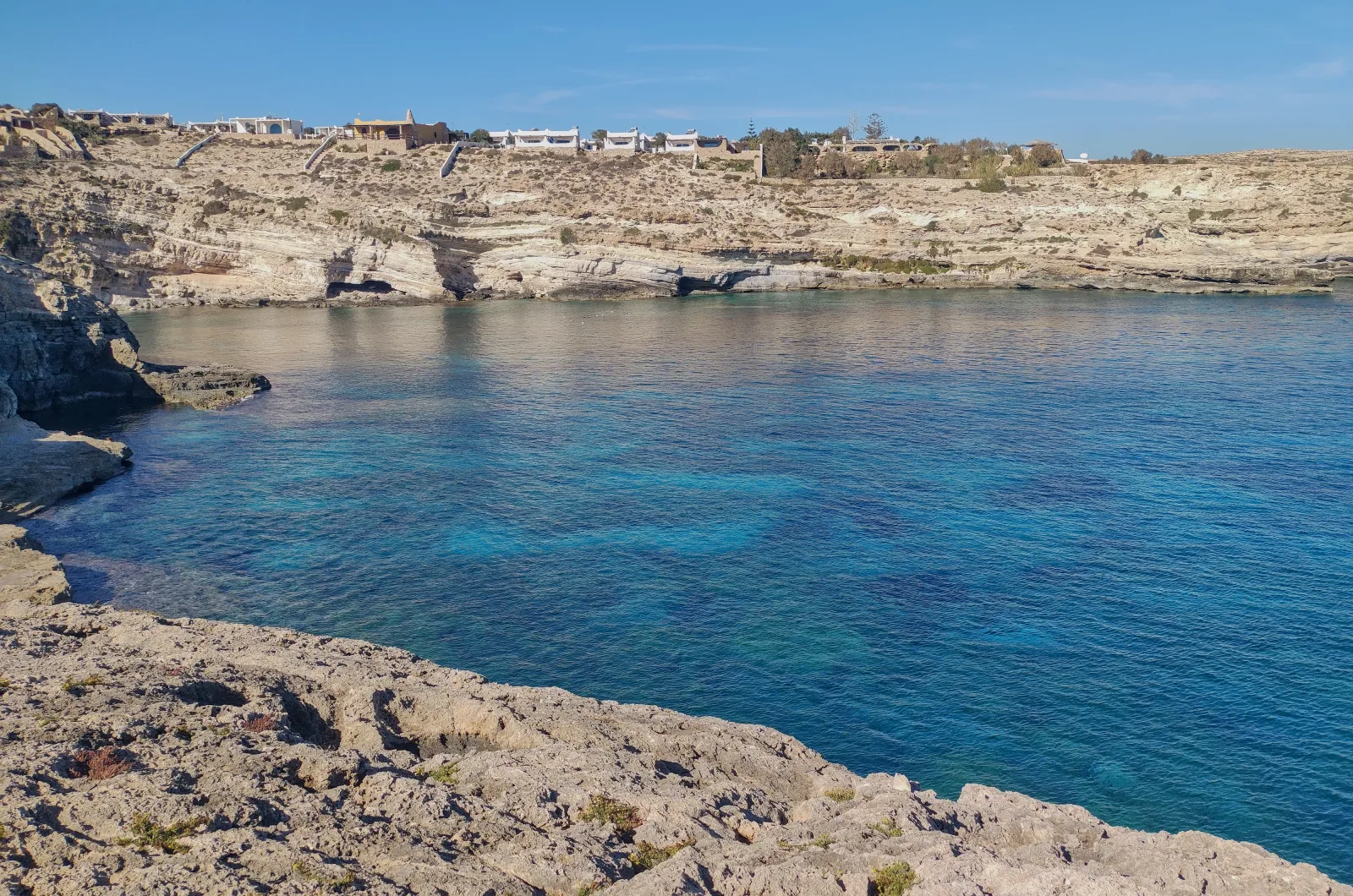
Cala Creta, a rocky cove where the sea gets deep at once
No sand here, and no comfortable towel. At Cala Creta you drop into the water off the rocks, and under the mask one of the best seabeds on the island opens up. Sheltered when the sirocco blows.
Tomorrow: sirocco (south-easterly) 8 knots. This cove is sheltered, the sea should be calm. Full wind guide
Cala Creta sits on the eastern side of Lampedusa, outside town, and it is not a beach. It is a cove of low, flat rock slabs, with a couple of ladders and a concrete platform used as a sun deck, where the stone ends and the water begins with no transition. If you came looking for sand and an umbrella, you will be disappointed in two minutes. If you came with mask and fins, you will understand straight away.
The seabed is what makes the difference. A few metres out the depth builds quickly, and the bottom alternates rock, tufts of posidonia and patches of pale sand. That alternation gives the water the greens and blues you see from above, and it keeps so much life within one breath of the surface. You need neither a boat nor a long swim. Ten metres from the edge, your head under water and a little patience are enough.
| Access | by car or scooter |
|---|---|
| Distance | 2.5 km from town, 35 minutes on foot |
| Seabed | rock |
| Depth | deep straight away |
| Shade | none |
| Facilities | kiosk |
| Parking | limited |
| With children | with care |
| Snorkeling | among the best on the island |
| Sheltered from | sirocco (south-easterly), southerly (ostro), south-westerly (libeccio), westerly (ponente), mistral (north-westerly) |
| Exposed to | easterly (levante), north-easterly (grecale) |
Getting there
- From town take the road towards the Capo Grecale lighthouse and follow the signs for Cala Creta.
- On a scooter it takes just a few minutes, on foot it becomes a long walk with no shade, so a vehicle is the better option.
- The last stretch is a short dirt track, so drive it at walking pace and leave the vehicle in the clearing, which is small.
- From the clearing it is a two minute walk down to the rocks and to the platform that almost everyone uses to get in.
- In summer there is usually a kiosk near the entrance, but do not count on it and check opening hours and services on the spot.
How you get in, and why you need reef shoes
The easiest way in is off the platform and the ladders, two steps, one rung and you are in. There is no shallow band where you can get used to the temperature, so take your time. Elsewhere along the cove you drop straight off the rock, and there the problem is not the depth but the surface, because wet stone, with the film of algae along the waterline, is as slippery as soap. Falls here happen standing up, not swimming.
That is why reef shoes are not a fussy extra. They let you walk on hot, uneven rock, get in without cutting yourself and above all get out again, which is the delicate part: with a little swell the water lifts you and sets you down again, and you want grip under your feet. Work out your exit point before you swim off, and come out where you went in.
What you see through the mask
A few metres from the rocks you get the familiar cast of a healthy Mediterranean rocky bottom, shoals of dark damselfish hanging above the stone, salema grazing on algae, white bream and saddled bream along the boulders, bright rainbow wrasse rummaging in the sand. In the cracks, looking calmly, octopus and small conger eels turn up, while starfish and sea urchins sit on the posidonia. Nothing is guaranteed, but it is rare to come back having seen nothing.
If you swim away from the rocks, carry a surface marker buoy tied to your wrist or belt. Seen from water level a masked head is almost invisible to a motorboat, the buoy is not, and in a cove with passing boats it is the only thing that makes you visible. The local rule applies too: this is the Isole Pelagie Marine Protected Area, so you look and do not touch, collect no organisms or shells and do not feed the fish.
Sun, the right hour and the wind
There is no shade, and the pale rock throws heat back at you from below, so at midday in August the cove turns into a hotplate. Early morning is the best moment, with calmer water, low light and colours that read better through the mask; late afternoon is the second choice, with fewer people. On wind, Cala Creta has a precise role. It faces east, so when the sirocco (south-easterly) blows and the south coast turns choppy, the sea here stays workable. With an easterly or a north-easterly the swell comes straight in and getting off the rocks becomes a bad idea.
The kit that makes the day
Reef shoes, your own mask and a stiff mat instead of a towel, which does not last long on rock. Add plenty of water, a hat and a water resistant sunscreen.
Small children need close watching
There is no gradual shelf here, one step and you are already in deep water, and wet rock is slippery. Armbands and half an eye are not enough. If your children are not confident swimmers, pick a cove with a shallow sandy bottom instead.
Where Cala Creta is
Nearby coves
Frequently asked questions
Is Cala Creta suitable for children?
It depends on their age and on how well they swim. There is no sand, no shallow water, and you get in off rocks or off a platform. For a child who swims well and is comfortable with a mask it is great fun, for a small one it is an environment that needs close, undistracted supervision. With very young children, on the same east coast, Cala Pisana is easier to manage.
Do I really need reef shoes?
Yes, they are the single most useful thing you can put in your bag. The rock is uneven and burning hot in the sun, the waterline is covered by a slippery film of algae, and getting out of the sea with a little swell running needs grip under your feet. You put fins on in the water, reef shoes are for before and after, the two moments when people get hurt.
When should I come, in terms of wind?
Cala Creta is the choice for sirocco days, when the south-easterly makes the south coast beaches choppy and cuts the visibility underwater. Conversely, with an easterly or a north-easterly the swell comes straight into the cove and getting in off the rocks turns awkward. Check the forecast the evening before and change side of the island, not time of day.
Can I snorkel on my own, and do I need a marker buoy?
You can swim close to the rocks without trouble, but as soon as you move out the surface marker buoy is the only thing that makes you visible to passing boats. Tie it to your wrist or belt rather than letting it float free. Better still, do not go alone, because two people keeping an eye on each other beat any piece of equipment.
Is there shade, and are there any services?
Natural shade is essentially absent, the cove is rocky and open and in the middle of the day the sun is relentless. In summer a kiosk usually operates near the entrance, but hours and services change from season to season, so check on the spot. Parking is a small clearing, and in August it pays to arrive early.