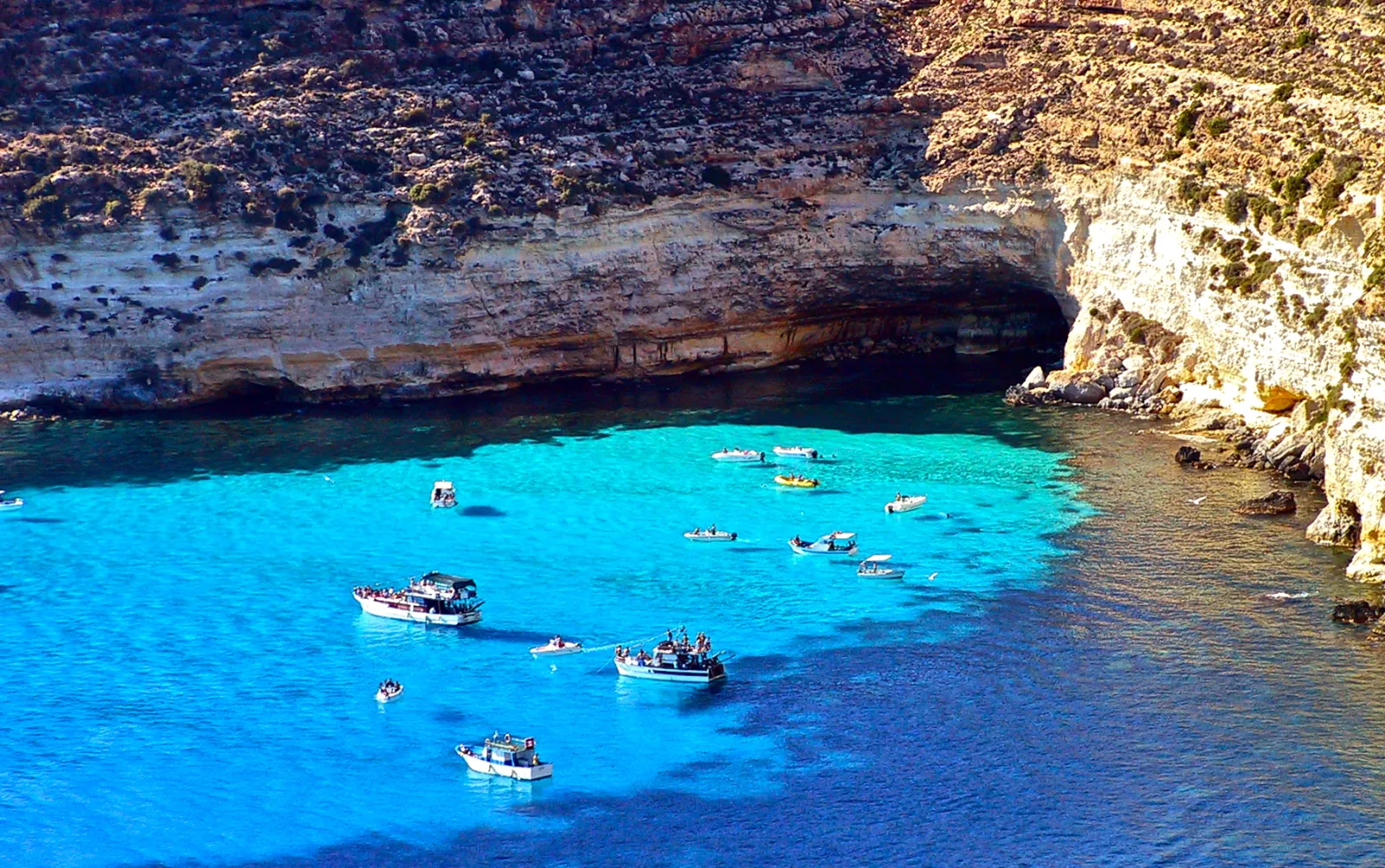
Tabaccara, where anchored boats look like they are floating on air
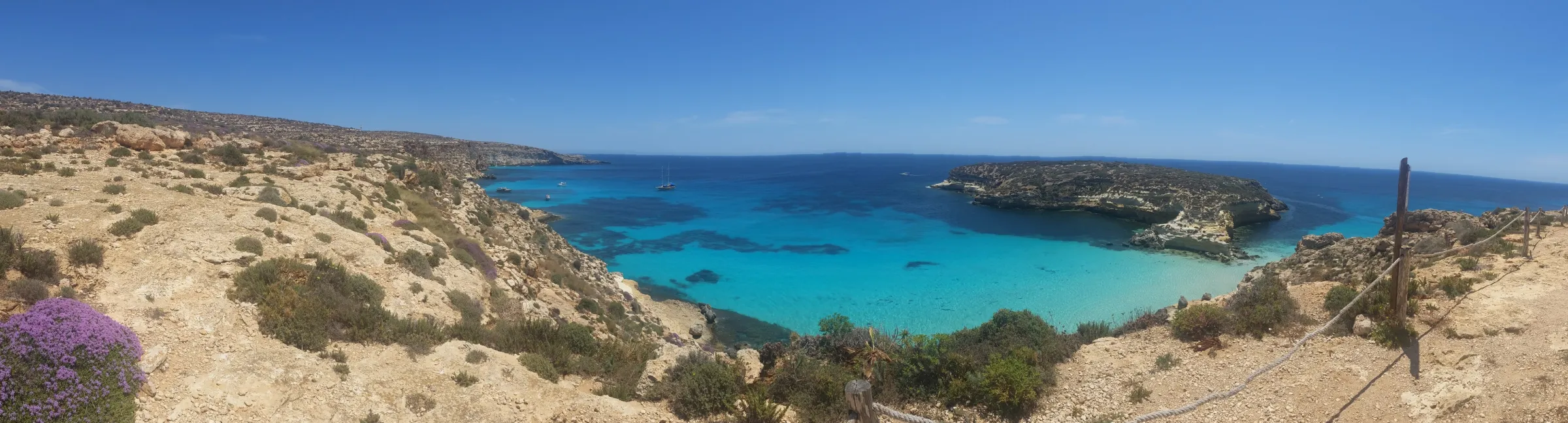
It is not a beach and there is no shore to lie on. Tabaccara is a patch of sea on the south-west coast that you reach by boat, jump into and look straight down through.
Tomorrow: sirocco (south-easterly) 8 knots. Cross wind: conditions vary, check before you go. Full wind guide
Tabaccara lies on the south-west coast, between Cala Galera and Rabbit Island, and it never shows up on beach lists because it simply is not one. It is a pool of water walled in by pale rock, with no strip of sand to land on. Most people know it from photographs of anchored boats that seem to hang in mid air, the shadow of the hull printed on the bottom a few metres below. The effect is real, but it only lasts while the sun stays high.
That is why Tabaccara is the fixed stop on almost every island boat trip. You leave the harbour in the morning, follow the south coast, and here the engine goes quiet for the first long pause of the day. Nobody comes to sunbathe. You come to be in the water with a mask and snorkel, for as long as the crew allows before heading on towards Rabbit Island and the north coast. From land you can only look down on it.
| Access | by sea only |
|---|---|
| Seabed | rock |
| Depth | medium |
| Shade | none |
| Facilities | none |
| With children | with care |
| Snorkeling | among the best on the island |
| Sheltered from | northerly (tramontana), north-easterly (grecale), easterly (levante) |
| Exposed to | southerly (ostro), south-westerly (libeccio), westerly (ponente) |
Getting there
- Book an island boat trip the day before rather than on the morning itself, especially in August.
- Alternatively rent a small dinghy and follow the coast westwards, it is not far from the harbour.
- Check the wind forecast the evening before, because a south-westerly swell shortens or cancels the stop.
- Pack your own mask, snorkel, water and sunscreen, because nobody goes ashore here and there is nothing on site.
- If you are staying on land, a few unmarked paths lead from the road towards Rabbit Island and Capo Ponente to the top of the cliff, so wear closed shoes.
Why the water looks empty
The colour is not a filter. The bottom is pale, almost white rock broken up by tongues of sand, and it throws nearly all the light it receives back upwards. The water above stays still and low in sediment, because the basin is enclosed and no beach surf stirs it up. Light makes the journey twice, down and back, and the real depth disappears. A hull sitting over five or six metres of water looks as if it were resting on glass.
The effect depends on the hour. You need the sun high, roughly between eleven and two in the afternoon, when the rays go in almost vertically instead of bouncing off the surface. Before and after that the blue is still lovely but the bottom goes dull and photographs fall flat. It is also why boat itineraries are built the way they are, arriving here in mid morning.
What the stop is actually like
The pause usually runs from half an hour to an hour, rarely longer, because the crew still has Rabbit Island, lunch and the north coast ahead. You get in from the boat, normally down a ladder at the stern, and climb back out at the same spot. There is no shore, no towel to spread out, no shade beyond the awning. Anyone prone to seasickness is better off sitting and watching, because with the engine off the hull rolls a fair amount.
Bring your own mask and snorkel from home. There is usually some spare gear on board, but it is generic, often fogged and rarely your size, and half an hour goes fast if you spend it adjusting a strap. Fins are convenient rather than essential, while a long sleeved rash top worn in the water saves your back from a burn that creeps up unnoticed here.
Group trip or your own dinghy
An organised trip takes you where the crew knows to go, explains what you are looking at and asks no boating skill of you, but it sets the timing. You arrive when several boats are already anchored and you leave when the skipper says so. A small rented dinghy turns that around, because you pick the hour, you can slip in early or after the early afternoon queue, and you stay in the water as long as you like. In exchange you take on the navigation, the anchoring and the forecast.
Marine park rules and the seabed
You are inside the Isole Pelagie marine protected area, and the rules apply even to a short stop. Collect nothing, do not touch the organisms fixed to the rock, do not feed the fish. The anchor must never go down on posidonia meadows, the dark patches you can see on the bottom, and where mooring buoys exist you use those. Zoning changes from stretch to stretch and the belt around Rabbit Island is the most strictly protected, so check the current rules on the marine protected area website before taking a boat out yourself.
Ask about the timing before you book
When you book the trip, ask what time the Tabaccara stop is scheduled. Mid morning departures get here with the sun high, while afternoon ones often pass by on the way back, when the bottom has already lost its light. It is the one question that genuinely changes the day.
Do not try to swim there
Tabaccara has no land access and it is not a swim to attempt. The walls are high and sheer, there is nowhere to climb out and rest, and the water is crossed constantly by boats and dinghies whose crews cannot see you from above. From the coast you look down on it, and the only way into that water is on a boat.
Where Tabaccara is
Nearby coves
Frequently asked questions
Can you reach Tabaccara from land?
No. There is no path down to the water, because the cove is closed in by high vertical rock walls with no beach and no landing point. The road towards Rabbit Island and Capo Ponente leads to a few viewpoints from above, which are excellent for photographs, but getting into the water requires a boat. Do not attempt to swim across from a neighbouring cove.
How long does the stop last on an island trip?
Usually between half an hour and an hour, depending on the itinerary and on how many stops are still to come. Full day trips tend to linger, half day ones move on quickly. If snorkelling is your main interest, ask before booking and consider a dinghy outing instead, where the timing is entirely yours.
Is a group trip or a rented dinghy better?
It depends what you want. A group trip is comfortable, needs no boating experience and often includes lunch on board, but it runs to a fixed schedule and arrives when the cove is already busy. With a small dinghy you choose the hour, stay in the water as long as you like and move on if it gets crowded, but you have to handle the boat and read the weather.
Should I bring my own mask and snorkel?
Yes. There is nearly always some courtesy gear on board, but it is generic and not always in good condition, and on a short stop you do not want to lose minutes hunting for the right size. Add a long sleeved top to keep on in the water, because the sun overhead burns a wet back without you noticing.
Which wind cancels the Tabaccara stop?
When it blows from the south-west or the west the sea runs straight into the cove and the water loses its clarity, so the stop gets shortened or swapped for somewhere else. With wind from the north, north-east or east it stays flat here. Strong wind from any quarter can cancel excursions altogether, so check the forecast the evening before.